August 17, 2025
· 6 min readDemystifying Transformers: A Developer's Guide to Understanding LLMs
Ever wondered how ChatGPT actually generates text that makes sense? This comprehensive guide breaks down transformer architecture, attention mechanisms, and the training process in developer-friendly terms - no PhD required.
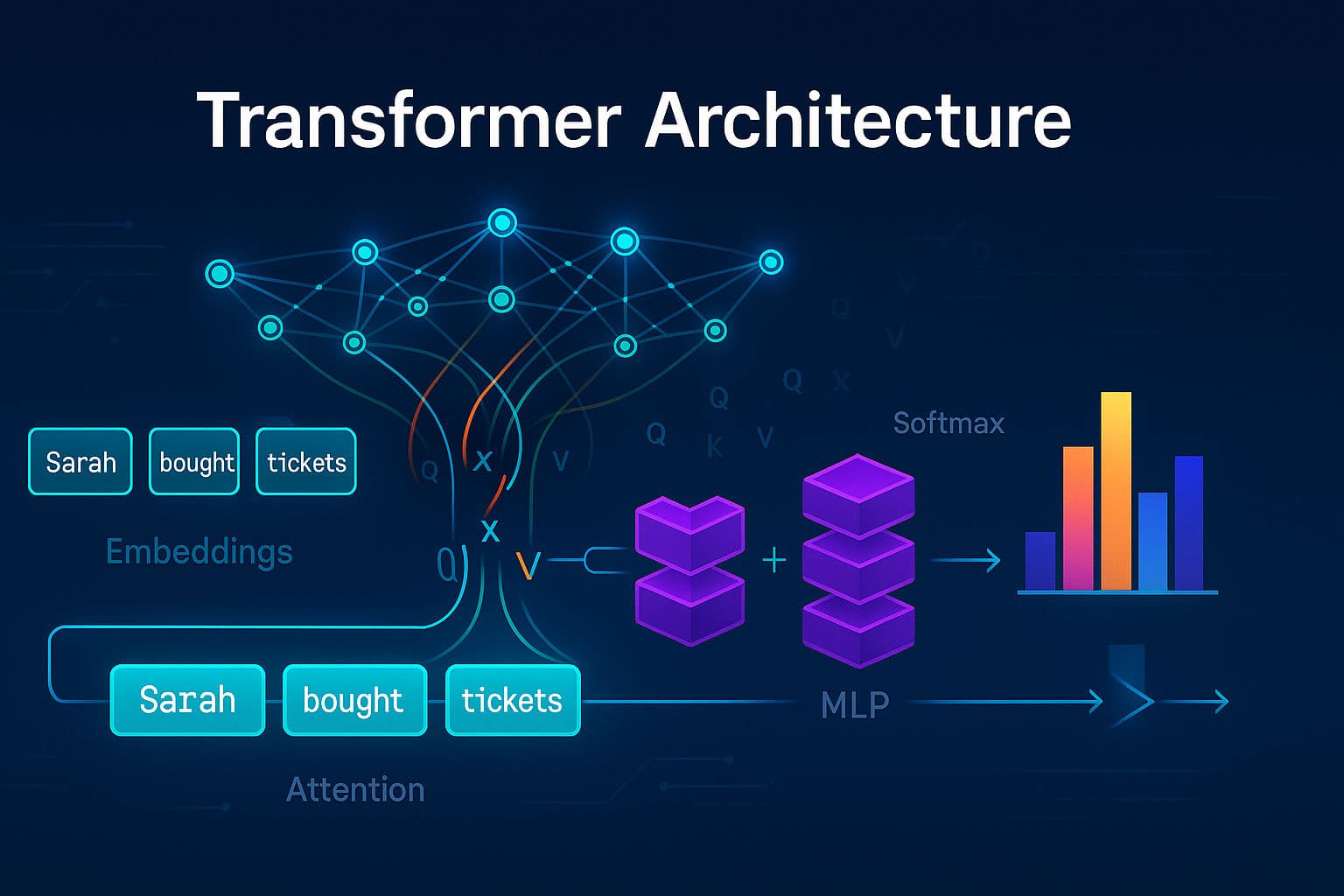
The Magic Behind the Curtain
You've probably used ChatGPT, Claude, or another language model and marveled at how it generates coherent, contextual responses. It feels like magic - but it's actually an elegant combination of mathematics, engineering, and massive scale. Let's pull back the curtain and understand exactly how these transformer models work.
Why Transformers Changed Everything
Before transformers, we had sequential models like RNNs and LSTMs that processed text word by word. Imagine trying to understand a sentence by reading it through a narrow window that only shows one word at a time - by the time you reach the end, you've forgotten the beginning.
This created three critical problems:
- Context loss: Important information got lost over long sequences
- Sequential bottleneck: Each word had to wait for the previous one
- Ambiguity resolution: Words with multiple meanings couldn't be disambiguated
Consider: "Sarah bought tickets but they expired." What does "they" refer to? The tickets, not Sarah - but a model that forgets early context might struggle with this reference.
Transformers solved all three through parallel processing and attention mechanisms.
The Architecture: A Highway of Context
Think of a transformer as a highway where information flows from input to output, with multiple stops that add context along the way:
Each stop adds crucial information without losing what came before - it's additive context building.
Enjoyed this post? Follow on LinkedIn for more engineering insights.
Step 1: From Words to Numbers
Tokenization: Breaking It Down
Before a model can process text, it needs to convert words into numbers. Modern models use subword tokenization:
"unhappiest" → ["un", "happ", "iest"]This is smarter than word-level tokenization because:
- It handles rare words by breaking them into known parts
- It captures morphological relationships (un-, -ed, -ing)
- It keeps vocabulary size manageable
Word Embeddings: The Translation Layer
Each token gets converted into a high-dimensional vector (think: a list of numbers) that captures its meaning. Initially random, these vectors learn to encode semantic relationships through training.
# Simplified example
cat_vector = [0.2, -0.5, 0.8, 0.1, ...]
dog_vector = [0.3, -0.4, 0.7, 0.2, ...]  # Similar to cat
apple_vector = [-0.8, 0.9, -0.2, 0.6, ...] # Very different
The famous example: king - man + woman ≈ queen works because these vectors capture relationships in geometric space.
Positional Embeddings: Order Matters
Since transformers process all words simultaneously, we need to tell them about word order:
- "A cat sat on the mat"
- "A mat sat on the cat"
We add positional information to each word embedding, originally using sine and cosine waves, now often using more advanced rotational embeddings.
Step 2: The Attention Mechanism
This is where the magic happens. Attention lets every word "talk" to every other word simultaneously.
Query, Key, Value: The Social Network Analogy
Think of attention like speed dating for words:
- Query: "What am I looking for?" (Your dating profile questions)
- Key: "Here's what I offer" (Other people's profiles)
- Value: "Here's who I really am" (The actual person behind the profile)
Every word creates queries, keys, and values from the same input embeddings but with different learned weights. The math is surprisingly simple:
Attention(Q,K,V) = softmax(QK^T / √d_k)VThis dot product measures similarity - higher scores mean stronger relationships.
Multi-Head Attention: Specialists at Work
Instead of one attention mechanism, we use many heads that specialize:
- Head 1: Focuses on grammatical relationships
- Head 2: Tracks entity references
- Head 3: Identifies temporal sequences
- Head 4: Captures semantic similarity
Think of it as having multiple expert analysts each looking at the same data from different angles.
Step 3: MLP - The Knowledge Processor
After attention gathers information (the "group discussion"), MLP blocks process it individually (the "self-study"):
MLPs contain ~75% of the model's parameters and act as the "memory bank" where factual knowledge is stored. They take the relationship information from attention and make concrete decisions about meaning.
Training vs Inference: Two Different Modes
Training: Learning from Complete Examples
During training, the model sees complete sentences:
Input:  "Sarah bought tickets but they"
Target: "expired"
If it predicts "sang" instead of "expired", backpropagation adjusts billions of parameters to make "expired" more likely next time.
Inference: One Token at a Time
During use, it only gets your prompt and generates one token at a time:
Input: "The cat sat on the"
Generate: "mat"
New Input: "The cat sat on the mat"
Generate: "and"
...
This autoregressive process continues until the model generates a stop token or reaches a limit.
Modern Innovations
Scale Effects
The transformer architecture scales remarkably well. More parameters, more heads, and more data consistently improve performance:
| Model | Parameters | Heads | Context Length |
|---|---|---|---|
| Original Transformer | 65M | 8 | 512 |
| GPT-3 | 175B | 96 | 4,096 |
| GPT-4 | ~1.7T | Unknown | 32,768+ |
Chain of Thought Reasoning
Modern models can "think step by step" by generating intermediate reasoning before final answers:
Question: What's 127 × 34?

Model thinks: Let me break this down...
127 × 34
= 127 × (30 + 4)
= 127 × 30 + 127 × 4
= 3,810 + 508
= 4,318
Mixture of Experts (MoE)
Instead of activating all parameters, route inputs to specialized "expert" networks:
- Math expert for calculations
- Code expert for programming
- Language expert for translation
This allows models with 800B total parameters to only use 20B per forward pass.
Putting It All Together
A transformer is essentially a contextual machine that:
- Converts text to numerical representations
- Adds positional information
- Uses attention to let words communicate
- Employs MLPs to process and store knowledge
- Repeats this process through many layers
- Outputs probability distributions over possible next tokens
The entire process is matrix multiplication and addition - no complex math required. The complexity comes from scale and the emergent behaviors that arise from billions of parameters trained on massive datasets.
Key Takeaways
- Transformers process all words in parallel using attention mechanisms
- Attention is like social networking - words ask questions and share information
- MLPs are the knowledge storage - they contain most of the model's learned facts
- Training shows complete examples while inference generates one token at a time
- Scale effects are real - bigger models consistently perform better
- The math is surprisingly simple - mostly matrix operations that any developer can implement
Understanding transformers demystifies AI and reveals the elegant engineering behind what seems like magic. These models aren't conscious or truly "intelligent" - they're sophisticated pattern matching systems that have learned incredibly rich representations of language and knowledge through massive scale and clever architecture.
References
- Attention Is All You Need - The original transformer paper
- The Illustrated Transformer - Visual explanations
- 3Blue1Brown Neural Networks - Mathematical foundations
- Hugging Face Transformers - Implementation library
- TikToken - Tokenization visualization tool
- Papers With Code - Latest research
FAQ
What's the difference between RNNs and Transformers?
RNNs process words sequentially and suffer from memory loss over long sequences. Transformers process all words in parallel using attention mechanisms, allowing them to maintain context across entire sequences while being much faster to train.
How do transformers understand word relationships?
Through the attention mechanism, where each word creates queries, keys, and values to 'ask questions' of every other word in the sequence. This allows the model to learn which words are most relevant to each other contextually.
Why do we need both attention and MLP layers?
Attention acts like 'group discussion' - gathering local information about word relationships. MLPs act like 'self-study' - processing that information to make concrete decisions. Attention has fewer parameters but MLPs contain 75% of the model's knowledge.
What happens during transformer training vs inference?
During training, the model sees complete sentences and learns to predict each next word. During inference, it only gets the initial prompt and generates one token at a time, using its learned patterns to continue the sequence.
How do embeddings capture word meaning?
Word embeddings convert tokens into high-dimensional vectors where similar concepts cluster together. After training, these vectors encode semantic relationships - like 'king - man + woman ≈ queen' in vector space.
What makes modern models like GPT-4 so much better?
Scale effects - more parameters, more attention heads, longer context windows, and better training data. Models have grown from 12 attention heads to 48+, with billions more parameters enabling richer understanding and generation.