August 20, 2026
· 6 min readThe Agentic Loop: When AI Should Think, Act, and Loop (and When It Shouldn't)
Every AI system you rely on — scripts, watchdogs, coding agents, Grok bots — runs the same core loop: observe, decide, act, verify. This post breaks down that loop, the two ways to put a human around it, and a practical framework for deciding when an agentic loop earns its cost and when a plain script wins.
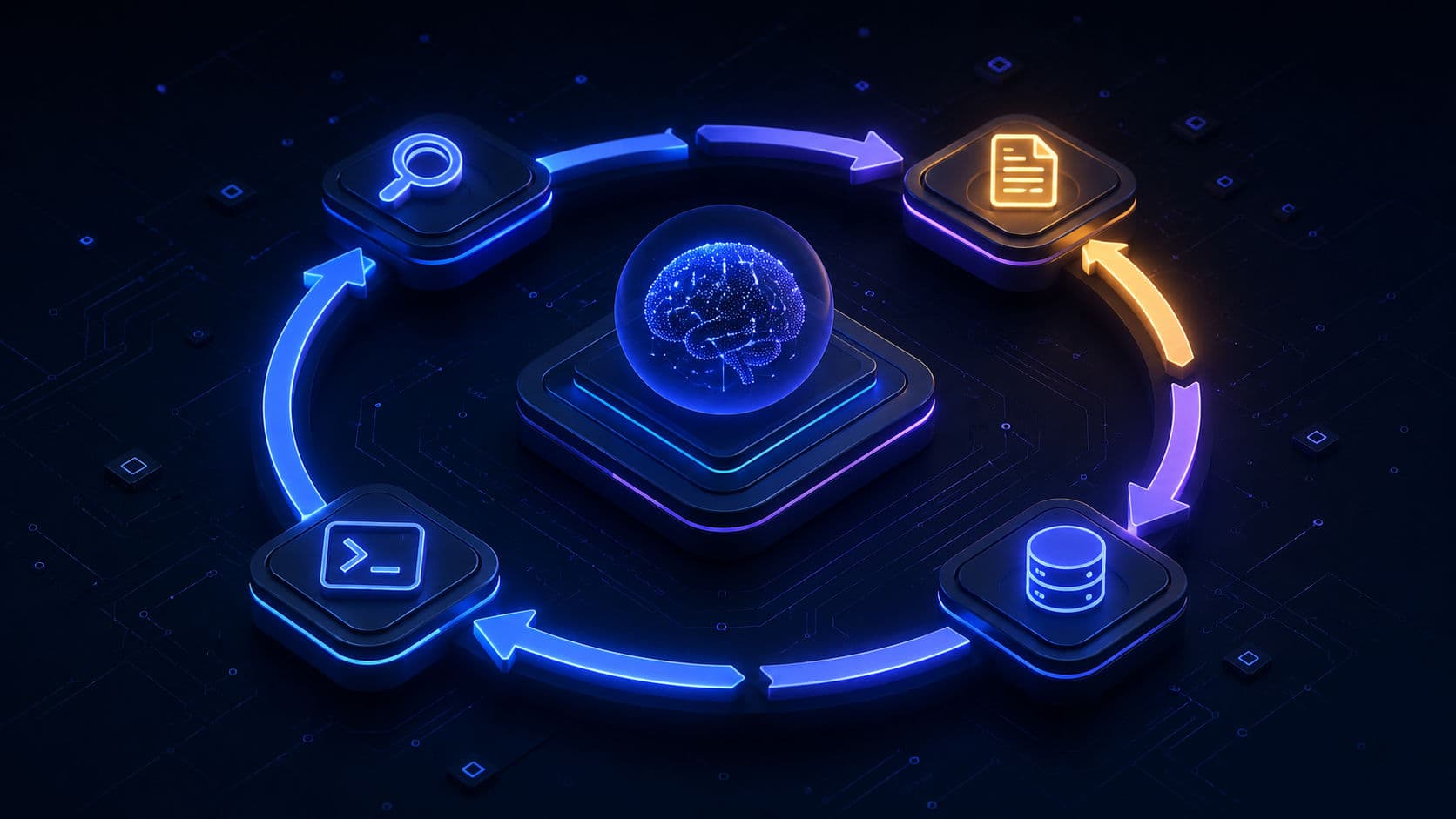
Every AI agent you rely on runs the same loop: observe, decide, act, verify — repeat. Understand that loop and you finally know when to hand a task to an agent, and when to just run a script. This post walks the model, the guardrails, and the decision framework, grounded in how the actual tooling (Anthropic, OpenAI, and the frameworks) really works.
You've seen both failure modes. The AI answers confidently and stops — it never actually did the thing you asked. Or it runs away, hammering tools and burning tokens on work that keeps missing the mark. Both happen at the same boundary, and nobody explains that boundary. Once you see the loop underneath, both failures stop being mysterious.
That loop is the most important idea in applied AI right now, and it's shockingly simple. Grasp it and the "should I use an agent for this?" question answers itself.
What Makes an Agent an Agent
An agent is not a chatbot that's been told to sound robotic. The difference is mechanical — and it's exactly three things an LLM on its own does not have:
- Tools — hands. APIs, search, file access, database queries, a shell. The model can reach out and do something.
- Memory / context — state. Something to carry across steps so each decision sees what the last one produced.
- **The loop — persistence. It keeps deciding until the goal is met or the budget runs out.
An Anthropic engineering guide frames it plainly: the model with a decent tool set and clear instructions forms the "heart" of an agent. The loop is what turns that heart into a worker instead of an oracle.
That cycle — observe → decide → act → observe — is the entire secret. A single pass is a (chatbot). The loop is what makes it an agent.
The Loop, Worked
Here's the loop running against a real goal so you can see the turns:
Goal: find three AI startups in San Francisco and log them with their address to a Google Sheet.
- Turn 1: the model picks a search tool → runs it → sees three promising companies.
- Turn 2: it opens a company website (another tool) → copies the address → decides this one qualifies.
- Turn 3: it calls a Sheets tool → appends a row with the company name and address.
- …repeat for the next two.
The key beat is the one everyone skips: between turns, the agent checks its own output. It doesn't just fire a tool blindly — it looks at what came back, decides whether it's good enough, and only then moves on. That self-verification is what separates a script that string-templates a URL from an agent that completes a task.
The Two Sides of the Loop
An agent is powerful precisely because it runs without you pressing a button at each step. But unattended and unsupervised are different things. There are two ways to wrap a human around the loop:
| Human-in-the-loop | Human-on-the-loop | |
|---|---|---|
| Who approves | Every single step | Key checkpoints |
| Speed | Slow, safe | Fast, gated |
| Best for | New/unknown agents, irreversible actions | Routine autonomous runs |
| Outbound effect | Person sees everything | Person approves anything that sends or ships |
The rule is blunt: any loop that can mutate state or send data out should be human-on-the-loop. It reads, it prepares, it drafts — and a person approves before anything actually leaves. That's the same pattern a well-built agent follows, and it's the one place a "don't trust me" moment is non-negotiable.
When an Agent Is the Wrong Tool
Here's the part most agent hype refuses to say: most of your automation should not be an agent at all.
⚠️ The script trap. If a task is deterministic — same input, same correct output, every time — an agentic loop just burns tokens and latency. A script is cheaper, faster, and never "decides" something wrong.
| Task | Agent or script? | Why |
|---|---|---|
| New-mail → push alert | Script | Fixed mapping, zero reasoning |
| Disk-full / GPU-threshold alert | Script | Comparison, not judgment |
| "Summarize my inbox, flag urgent" | Agent | "Urgent" is fuzzy |
| "Fix the failing test, run, iterate" | Agent | Needs self-correction |
| Price-watch "under ₹X" | Script | Deterministic threshold |
| Research + synthesis with a take | Agent | Needs relevance judgment |
Your Gmail watchdog is the no-agent example done right: a plain Python script that polls IMAP and prints the new subject and snippet — no reasoning, no tokens, correct every time. It's not an agent, and that's a feature. (You'll notice it's also exactly the loop — task → check → act → report — but with all judgment stripped out.)
A Framework for "Agent or Not?"
The decision is a flowchart, not a vibe:
With three rules of thumb on top:
- Deterministic → script. Same input, same output.
- Judgment + hands → agent. The task changes based on what it finds — agent loop.
- Anything irreversible gets a human gate — agent or script, doesn't matter.
Making the Loop Reliable
A loop that never stops is a bug with a bill attached. Keep an agent from galloping away with three guardrails:
- Clear exit criteria. The goal must be checkable — "finish when the sheet has three rows" beats "research startups."
- A budget. Turn limits, tool-call limits, and token/API budgets. Anthropic's guidance to "maintain simplicity" and OpenAI's practical guide to give clear, structured instructions are the same lesson: a loop without bounds is a leak.
- Approval gates. Gate anything that mutates state, sends an email, or deploys. The agent prepares; a human approves.
The Agent-Coding Crossover
The same loop is what base coding agents are: Claude Code, Cursor, Codex run build → run → see the error → fix, iterating until green. That's the loop wearing a developer hat, and it's exactly why a coding agent is only as good as the rules you give it — the more context it has (for Laravel: PSR-12, typed props, thin controllers, matching migrations), the better each loop iteration lands.
This is where the "agent" concept meets your actual workday: not a sci-fi robot, but the thing running your test suite and reading your codebase. The loop is the reason the rules you drop in a CLAUDE.md or AGENTS.md matter.
Final Thoughts
- The loop is the agent. Observe → decide → act → verify, repeated, is what separates an agent from a robot.
- Agents earn their cost where judgment and tools meet — research, synthesis, self-correcting code. Scripts win where deterministic "here it is" wins.
- The same loop drives your whole stack — watchdogs, coding agents, Laravel Boost, Grok bots — some just hold more of it than others.
- Guardrails aren't optional — exit criteria, a budget, and human approval on anything that ships. A loop without them is a leak with a better logo.
👉 Try it on your own stack. Find one task you currently script that actually needs judgment, prototype it with a small agentic loop, gate anything that sends or ships — and write the loop down so someone else trusts it. A script you understand is good; an agent you understand and can stop is better.
FAQ
What exactly is the agentic loop?
It's the observe → decide → act → verify cycle that makes something an agent instead of a one-shot chatbot.
The model picks a tool, the tool runs, the model sees the result, then decides the next step — repeating until the goal is met or the turn budget runs out.
What makes an agent different from a chatbot?
Three things: tools to act in the world, memory or context to carry state between steps, and the loop itself.
A chatbot answers once and stops; an agent keeps working toward a goal, checking its own output between turns.
When should I NOT use an agent?
When the task is deterministic — same input, same correct output every time. Threshold alerts, price checks, and fixed monitoring are scripts, not agent loops.
An agentic loop only pays off where judgment, tools, and self-correction meet: research, synthesis, or code that needs to fix itself.
What is 'human on the loop' vs 'human in the loop'?
Human-in-the-loop means a person approves every single step before it runs — safe but slow.
Human-on-the-loop means the agent runs autonomously but a person supervises and approves at checkpoints, especially anything that sends data out or mutates state.